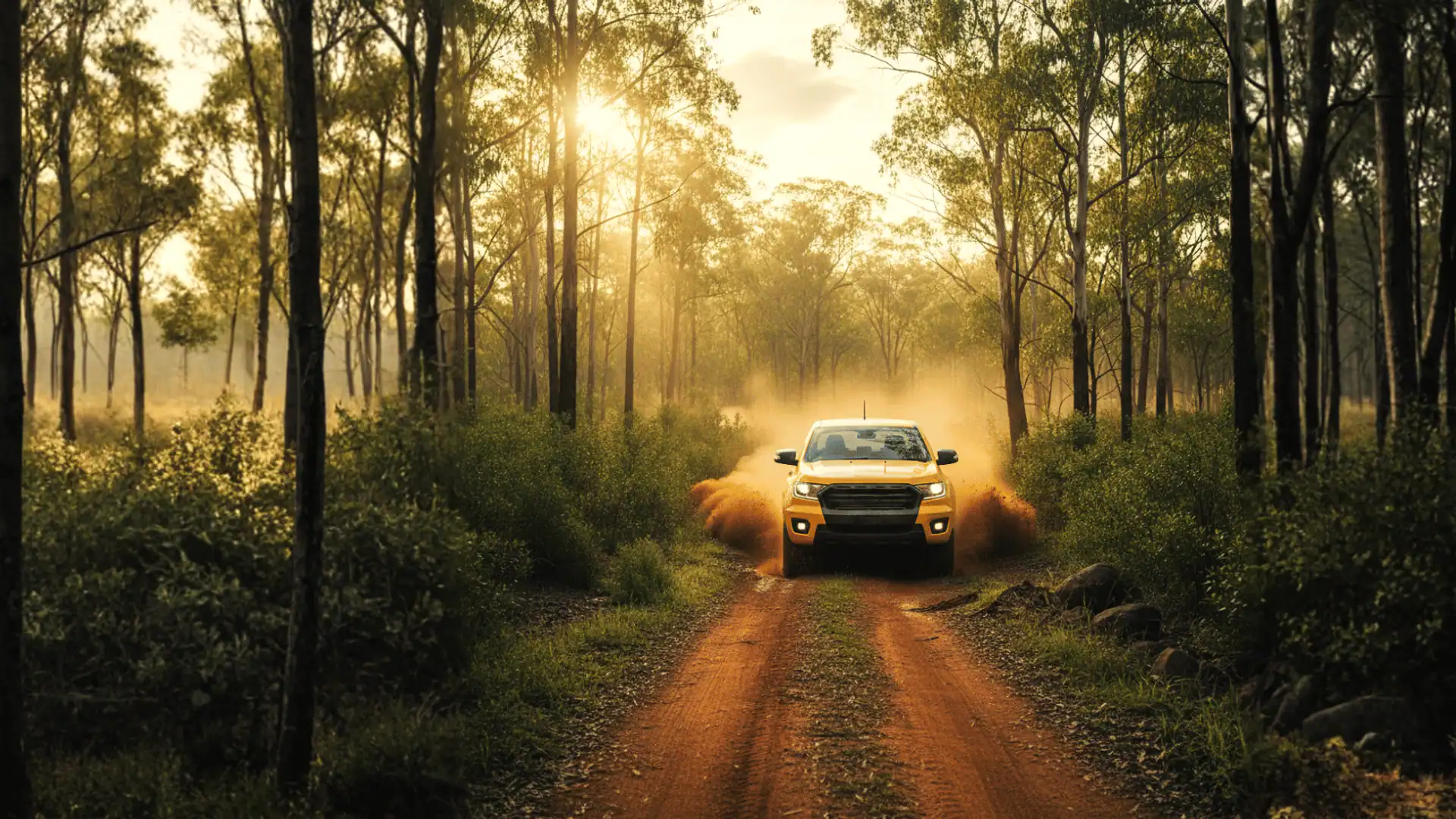

Mud and sand both call for airing down. They don't call for the same pressure. This post is about what changes when the track turns to mud, and how to set your TPMS so it still warns you early.
For the full surface-by-surface guide, see our 4WD tyre pressures guide. For the sand side of it, see TPMS for beach driving.
How much should you air down for mud?
Less than for sand. Our 4WD guide's quick reference starts mud higher than sand, in the same range as low-range rock work.
There's no single right number. It depends on your tyres, your load and the track. Your tyre placard gives the road pressure. Your tyre maker can tell you how low their tyre is meant to go.
Work down in small steps, not one big drop. If the vehicle is moving well, stop there.
What changes compared with sand?
On sand, you want float. A softer tyre spreads out and sits on top of the sand instead of digging in. That's why sand pressures go so low.
Mud is different. The aim is grip, not float. As our 4WD guide puts it, tread matters more than pressure in mud.
So in mud:
- A moderate drop is usually enough. It lengthens the footprint a little, without going as low as sand.
- Mud hides what's under it. Ruts, rocks and roots sit out of sight. Keep your speed down, because slow speed is what makes low pressure work.
- Spinning wheels need care. Go too low with wheels spinning, or turn too sharply, and a tyre can roll off the rim.
Set your TPMS low alarm before you air down
A low-pressure alarm set for the highway will go off as soon as you air down. Turning the TPMS off isn't the answer. That's when you'd miss a tyre that keeps losing air.
Set it for the mud instead:
- Before the track, set the low-pressure alarm a little under your mud pressure.
- Air down and watch each tyre come down on the screen.
- On the track, the alarm stays quiet unless a tyre drops below your setting.
- At the end, air back up and set the alarm back to your highway level.
Because your mud pressure is higher than your sand pressure, your mud alarm sits higher too. Don't carry the beach setting over to a muddy track.

The Aura A-Series lets you set the low-pressure alarm yourself from the buttons on the screen. Its alarms cover low and high pressure, leaks and high temperature, with a sound and on the screen. The sensors are IP67 rated for water and dust.
What should you watch on the screen in mud?
Watch for a tyre that doesn't match the others.
- One tyre reading lower than the one opposite. Stop when it's safe and check it with a gauge.
- A reading that keeps falling. That points to air loss, not just a cooler tyre.
- Temperature climbing on a soft tyre. A soft tyre run too fast heats up. Slow down until you've aired back up.
If the track takes in a creek, cold water cools the tyres, and pressure drops as a tyre cools. Readings come back up as the tyres warm again. Our post on tyre pressure and temperature explains why.
What to do after the mud
Mud packs into the tread and hides what's underneath. Stop somewhere safe and work around the vehicle wheel by wheel.
- Wipe or rinse the mud off each valve and sensor.
- Check every sensor is still on and the screen shows every tyre.
- Look over each tyre by eye for cuts, bulges and anything wedged in the tread.
Our post on TPMS and water crossings has the full after-the-creek routine, and it works for mud too.
A TPMS is an extra set of eyes. It does not replace checking your tyres by eye and with a gauge before you drive. Our pre-trip tyre check covers what to look at.
Air back up before the road
Every drop in pressure has to be paid back before you're back at highway speed. Driving on bitumen at trail pressures builds heat in the tyre.
The Surge Portable Air Pump runs from the 12 V socket, goes up to 150 PSI and has a digital gauge built in. It lets you air up at the end of the track, not at the next servo.
Your next step
Before your next muddy trip, check your tyre placard and ask your tyre maker how low your tyres can go. Then practise changing the TPMS low alarm at home, so it's a quick job at the track. Not sure which kit suits your 4WD? Answer a few questions in find my kit, or read more on 4WD TPMS.
Questions
Should I air down for mud as much as for sand?
No. Tread matters more than pressure in mud, so a moderate drop is usually enough. Sand needs the extra float of a lower pressure.
Will my TPMS beep when I air down for mud?
Not if you set the low-pressure alarm first. On the Aura you set your own low and high pressure alarms from the buttons on the screen.
Can TPMS sensors get wet and muddy?
The Aura and Guardian sensors are IP67 rated for water and dust. After a muddy track, wipe them clean and check each one is still on and reading.
Do I need to air back up after the mud?
Yes. Air back up before you return to highway speeds, and set your TPMS low alarm back to your road level.
Not sure what your rig needs? Email us your rig: info@flatmate-tpms.com