
Our 4WD tyre pressure guide gives a figure for each surface. This post is the routine for one surface: the long, rough corrugated road. It covers why hard tyres suffer there, how to come down in steps, and how to get back to road pressure.
Always start from your tyre placard or the tyre maker's figure. That is your highway pressure, and every step here works down from it.
Why do corrugations punish hard tyres?
Corrugations are rows of ridges across a dirt road. A tyre at highway pressure is stiff, so it can't soak them up well.
Here's what that means on the road:
- The bumps go straight through. A stiff tyre passes each ridge into the suspension and the body. You feel it in the steering and hear it in the load.
- The tyre skips. A hard tyre bounces from ridge to ridge instead of staying on the road. That leaves less rubber on the ground for steering and braking.
- Sharp stones bite. A softer tyre wraps around a sharp edge. A hard one is more easily cut by it.
Letting some air out lets the tyre flex over each ridge. The ride smooths out and the tyre stays on the road.
How do you air down in steps?
Don't drop straight to a number. Come down in steps and let the road tell you when to stop.
- Stop where the bitumen ends. Pick a firm, flat spot off the road.
- Note your highway pressure. That's your placard or tyre maker's figure.
- Let some air out of every tyre. Take each one down by the same amount.
- Match each axle. Both front tyres should read the same, and both rears.
- Drive a few kilometres. If the ride is still harsh or the tyres still skip, stop and take a little more out.
- Stay inside the guide's range. Our 4WD guide puts gravel at about 75 to 80 per cent of highway pressure.
Your tyres are warm from the highway when you stop, and warm tyres read higher than cold ones. So the figure on the screen won't match a cold figure exactly. That's fine here: go by the ride, and keep each axle matched. Our post on tyre pressure and temperature explains why.
Towing a van or camper on the dirt? The trailer's tyres need their own figure. See our caravan tyre pressure guide and our post on TPMS for a camper trailer.
What speed should you drive on corrugations?
Keep to 80 km/h or under once you've aired down. A soft tyre run fast runs hot, and heat is what wears a tyre out.
Lower pressure and lower speed go together. If you want to drive faster, you need more air back in the tyres.
Slow down further where the road demands it: loose patches, crests, dips and blind corners.
How a TPMS helps on a rough road
On a corrugated road everything shakes. A tyre going soft is hard to pick by feel.
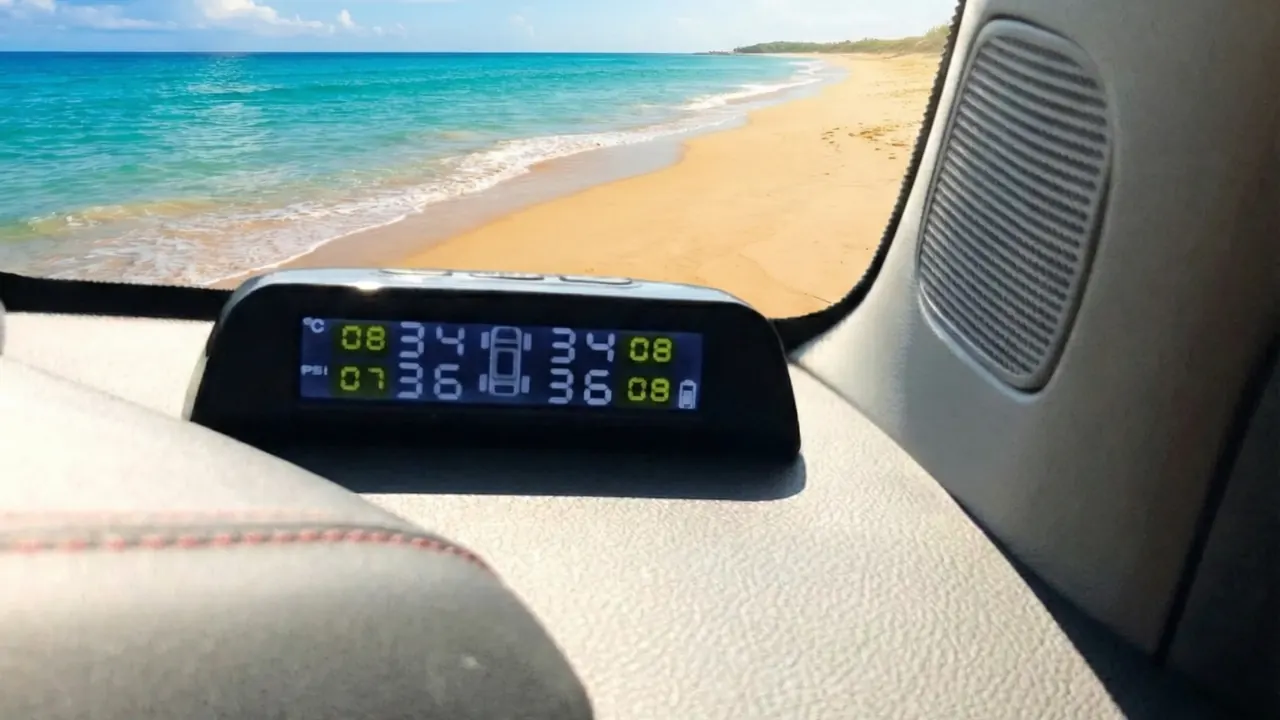
A TPMS shows the pressure and temperature of each tyre on one screen. That helps in three ways:
- Airing down. Watch each tyre come down on the screen as you let air out.
- Driving. A tyre that keeps dropping below the others points to air loss. Stop and check it with a gauge.
- Heat. Temperature on the screen shows you if a soft tyre starts to heat up.
On the Aura A-Series you set your own low-pressure alarm from the buttons on the screen. Set it a little under your gravel pressure before you air down, so it doesn't beep all the way. Its alarms cover low and high pressure, leaks and high temperature, with a sound and on the screen.

When should you air back up?
Air back up before the bitumen, not after. Low pressure on a sealed road at highway speed builds heat.
- Stop where the dirt ends. Firm, flat ground, well off the road.
- Pump each tyre back to your highway pressure. Use your placard or tyre maker's figure, not a guess.
- Check with a gauge or your screen. Match each axle again.
- Check again cold. Warm tyres pumped to the placard figure read a little low once they cool. Check them cold the next morning and top up.
- Set your TPMS alarm back. Return the low-pressure alarm to your highway level.
The Surge Portable Air Pump plugs into the 12 V socket and goes up to 150 PSI. It has a digital gauge and an emergency light built in.
Look over the tyres at the end
A TPMS reads pressure and temperature. It can't see the tyre itself.
At the end of a corrugated stretch, walk around and look at each tyre. Check for cuts, bulges and stones wedged in the tread. Make sure the screen still shows a reading for every tyre.
A TPMS is an extra set of eyes. It does not replace checking your tyres by eye and with a gauge before you drive. Our pre-trip tyre check covers what to look at.
Next step: find your highway figure on your tyre placard before the trip. Then use Find my kit to see which TPMS suits your 4WD, or browse 4WD TPMS.
Questions
Do I have to air down for every gravel road?
Not always. On a smooth, well-graded road, slowing down may be enough. Let air out when the ride turns harsh or the tyres start to skip.
Will my TPMS beep when I air down?
Not if you set the low-pressure alarm first. On the Aura the alarm is adjustable, so set it low before you let air out.
Should front and rear tyres be the same pressure?
Match the two tyres on each axle. Front and rear can differ if your placard gives different figures, so work down from each one.
Not sure what your rig needs? Email us your rig: info@flatmate-tpms.com