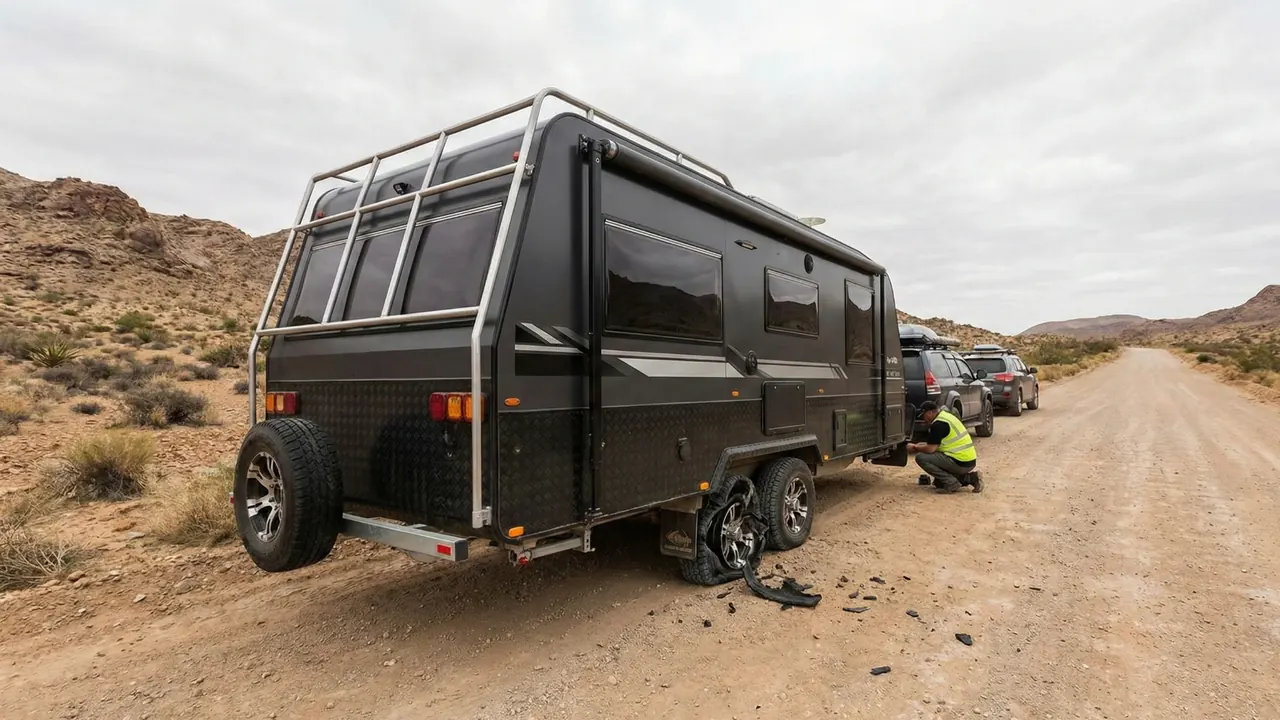

A boat trailer often sits between trips, then backs down a ramp into the water. This post covers the part our other towing guides don't: what to do with the sensors at the ramp, and what to check once the trailer is back out.
Why put a TPMS on a boat trailer?
From the driver's seat, you can't see the trailer's tyres. A tyre going soft behind you is hard to pick by feel.
A boat trailer also spends a lot of time parked. Tyres slowly lose air as they sit, so check them before the first drive after a break.
A TPMS puts a sensor on each tyre. It shows each tyre's pressure and temperature on one screen, trailer and tow vehicle together.
How many sensors does a boat trailer need?
One for every tyre you want watched. Count the whole rig:
- Tow vehicle: 4.
- Single-axle boat trailer: add 2, which makes 6.
- Tandem-axle boat trailer: add 4, which makes 8.
- Spare: add 1 for each spare you want watched.
Then match the count to a kit:
| Your rig | Tyres | Kit |
|---|---|---|
| Tow vehicle and single-axle trailer | 6 | Aura A6 Tow Pack or Guardian 6 |
| The same, plus a spare | 7 | Guardian 8 |
| Tow vehicle and tandem trailer | 8 | Guardian 8 |
| Tandem trailer, plus a spare | 9 | Guardian 10 |
The screen sets how many tyres a kit can watch. So buy for the rig you'll tow, spares included. The Sentinel and the Aura A4 Solo watch 4 tyres, so they can't cover the trailer as well.
The Aura A6 Tow Pack, $249, watches 6 tyres and has a pre-paired booster in the box. A Guardian 8 is $309. On a Guardian, the Signal Booster is an add-on. A booster carries the signal from the back of a long rig to the screen. Whether you need one depends on your rig.

Can TPMS sensors go under water at the boat ramp?
A splash is fine. Aura and Guardian sensors are rated IP67 for water and dust. But if the trailer's wheels go fully under water when you launch, take the sensors off first.
The sensors are external. They screw onto the valve stems, so you can take them off at the ramp. Here's a simple routine:
- At the top of the ramp, take the sensor off each wheel that will go under. Usually that's only the trailer's. On an Aura, undo each anti-theft locking nut first with the supplied tool.
- Screw a plain valve cap on each bare valve. It keeps grit and water out. Keep a set of caps in the car for this.
- Keep the sensors together somewhere dry in the car, so none go missing.
- Launch and retrieve as normal.
- Back at the top, rinse the trailer, then put each sensor back on the wheel it came off.
What should you check after a dunk?
Once the trailer is out of the water, run through these:
- Rinse with fresh water. After salt water, hose down the trailer, wheels and tyres before you refit the sensors.
- Look at each tyre. Check the tread and sidewalls for cuts or scrapes from the ramp.
- Expect lower readings at first. If the tyres were warm from the drive, the water cools them, and pressure drops as a tyre cools. Readings come back up as the tyres warm again. Our post on tyre pressure and temperature explains why.
- Compare tyres on the same axle. If one trailer tyre reads well under the one opposite, check it with a gauge before the highway.
- Remember what it watches. The TPMS reads the tyres. It doesn't watch wheel bearings or hubs, so look after those as your trailer maker advises.
If a tyre needs air, a Surge Portable Air Pump runs from the 12 V socket and goes up to 150 PSI, with a gauge built in.
What pressure should boat trailer tyres run?
We don't give a figure, because it depends on your tyres and how heavy the boat and trailer are. Start from the trailer maker's or the tyre maker's figure for your load. Our guide to caravan tyre pressure by weight shows how to weigh a rig first, and the same idea applies to a boat trailer.
Once you know the pressure, set the alarms to suit. On the Aura A-Series, the low-pressure alarm is adjustable. Its alarms cover low and high pressure, leaks and high temperature, with a sound and on the screen.
A TPMS is an extra set of eyes. It does not replace checking your tyres by eye and with a gauge before you drive. Our pre-trip tyre check covers what to look at.
Your next step
Walk around the tow vehicle and boat trailer and count every tyre, spare included. Find the pressure for your load from the trailer or tyre maker. Then answer a few questions in find my kit to see the kit that fits. Towing a camper as well? See TPMS for a camper trailer.
Questions
Can one screen show my car and boat trailer together?
Yes, as long as the kit has a sensor for every tyre. They all show on the same screen, so count the whole rig, spare included, when you choose a kit.
Can I move the sensors to another trailer or car?
Yes. External sensors unscrew, so you can move them, and the screen goes with them.
What if I'm not happy with the kit?
Use it on your rig. If you're not happy for any reason, send it back within 180 days for a full refund of the product price. The kit doesn't need to be unused. Return postage is on you.
Not sure what your rig needs? Email us your rig: info@flatmate-tpms.com